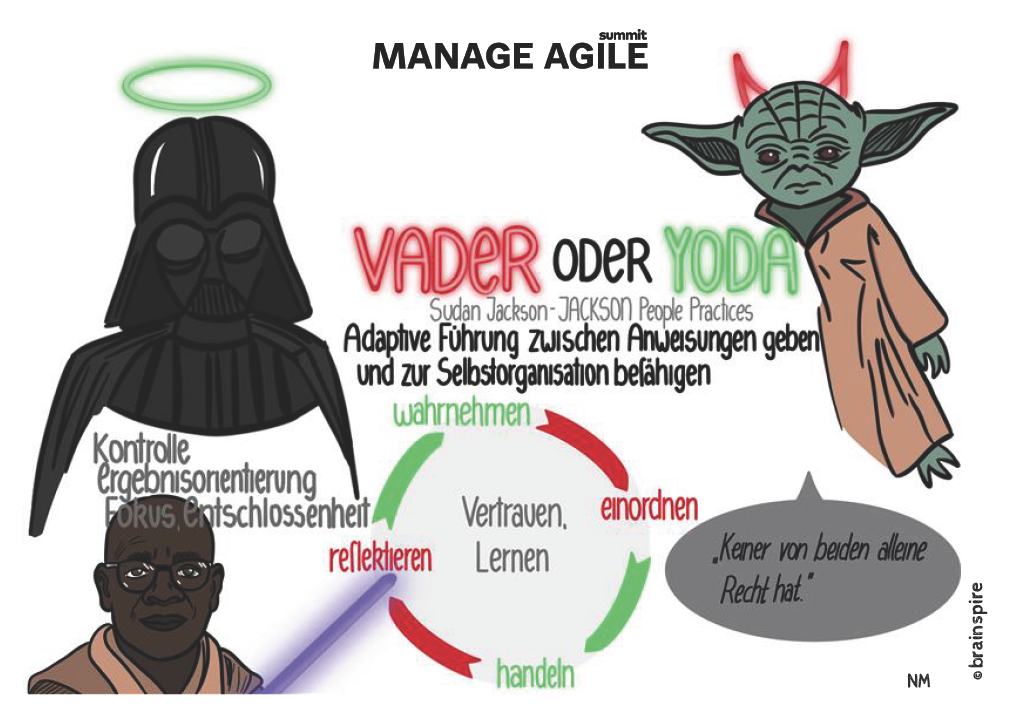
Vader or Yoda?Why Adaptive Leadership Is Not About Picking a Side
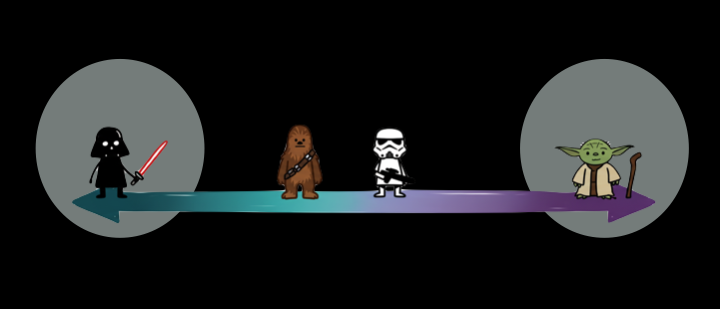
Adaptive leadership between directing and enabling self-organization
Leadership debates love false choices. Management or leadership. Control or trust. Direction or empowerment. As if effective leadership were a personality test with only one correct answer.
So let’s borrow a clearer image.
Vader or Yoda?
One stands for decisiveness, clarity and direction.
The other for wisdom, patience and enabling others.
It sounds like cinema — but it captures one of the most relevant leadership tensions of our time. Because leadership doesn’t fail when we choose the “wrong” style. It fails when we stop adapting.
When Vader Is Exactly What’s Needed
Vader gets a bad rap. Mostly because decisiveness is often confused with dominance.
But there are situations where leadership must be directive: crises, compliance issues, moments of high uncertainty. In those moments, teams don’t need endless dialogue — they need orientation.
Clear decisions reduce ambiguity. They create focus. They enable movement.
The problem starts when this becomes the default mode. Leadership turns into administration. Control replaces responsibility. Methods are enforced instead of understood. What once created clarity begins to kill ownership.
Vader has his place.
Permanent empire mode does not.
The Power — and Limits — of Yoda Leadership
Yoda represents what modern leadership rightly values: trust, learning, self organisation.
High performing teams don’t need micromanagement. They need space to think, experiment and grow. Leadership here means setting the frame, not pulling every string.
But empowerment without clarity quickly turns into drift.
Autonomy without direction becomes confusion.
Learning without decisions goes nowhere.
Self organisation doesn’t emerge by decree. It needs purpose, orientation and conscious leadership presence.
Wisdom alone is not enough.
Adaptive Leadership Means Context Before Method
This is where many organisations stumble.
They introduce agile frameworks and hope leadership will follow automatically. It doesn’t. Because methods don’t create leadership — and leadership isn’t static.
Adaptive leadership starts with reading the situation:
What does this team need now?
How experienced are they?
Is the challenge routine, complex, novel or critical?
Sometimes leadership means stepping forward. Sometimes stepping back. Often holding both.
Especially in hybrid or distributed setups, this becomes obvious. Presence alone doesn’t create connection. Tools don’t replace trust. And one-size-fits-all solutions rarely fit anyone.
What helps is reflection — a kind of method compass. Not “Which framework do we use?”, but “Which principles and formats make sense here?”
Conclusion: Stop Choosing Styles — Start Choosing Situations
So — Vader or Yoda?
The honest answer is: both. Just not always, and not automatically.
Adaptive leadership is not about identity, but awareness. Not about ideology, but judgement. It lives in one simple question:
What does my team need from me right now?
Clarity or space?
Direction or reflection?
Control or trust?
Notice your default mode this week. Observe when you stay in it too long. And practice switching — consciously, deliberately, context first.
Because great leadership isn’t about the light side or the dark side.
It’s about keeping the Force in balance.